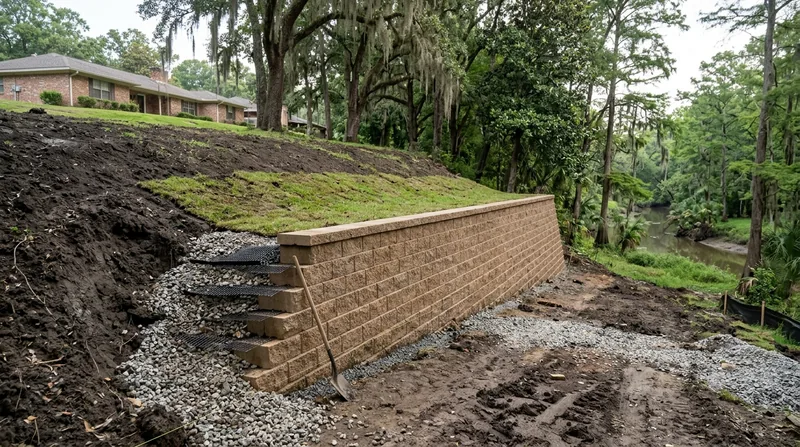




Baton Rouge sits on the first bluff above the Mississippi River, where the ground drops from the old terrace along Highland Road into bottomland laced with Bayou Fountain, Ward Creek and Dawson Creek. That terrain drives every wall we build. A retaining wall installation in Baton Rouge has to hold a raised slab on gumbo clay that swells in wet weather, shrinks in drought, and sits over a high water table. From the Creole cottages of Spanish Town to the brick ranches of Southdowns and the slab homes out in Shenandoah, the grade almost always needs structural help. We build walls on compacted bases with gravel backfill and real drainage, so they stay plumb through hurricane season and the August downpours that flooded this region in 2016. If an existing wall is already moving, start with leaning and collapsed wall repair before you plan anything new.
Why Retaining Walls Matter on Baton Rouge Bluff and Bayou Lots
The soil here is the whole story. Expansive gumbo clay pushes against a wall from behind, and a high water table saturates the backfill after every heavy rain. Add live oaks, magnolias and cypress dropping roots into the zone, and a wall built without drainage or proper base compaction will lean within a few seasons. That is why we treat water management as part of the installation, not an add-on.
- We excavate to a stable bearing layer instead of setting block on topsoil.
- We compact the base in lifts so the wall does not settle unevenly.
- We place gravel backfill and perforated drain pipe to move water away from the wall face.
- We tie tiered walls and driveway-support walls to engineered specifications when the load demands it.
Every one of those steps exists because of what this climate does to a wall over ten or twenty years.
Key info: A wall holding a raised slab off Highland Road near the University Lakes carries a surcharge load, so it needs a deeper base and stronger drainage than a low garden wall in Beauregard Town. We size the design to the load, not to the look.
Before any work starts, confirm the rules with the local building department. East Baton Rouge Parish and the City of Baton Rouge generally require a permit for walls above roughly 4 feet measured from the footing, or when the wall supports a driveway or structure, and engineered drawings may be required for tall or tiered walls. You can verify current thresholds through the City of Baton Rouge parish government before you commit to a design.
How We Build a Retaining Wall in Baton Rouge, Step by Step
We start with the site, not the material. On a bayou-bank lot off Ward Creek or a terraced yard in Shenandoah, the first visit tells us where the water goes, how deep the clay sits, and whether the wall needs to hold a pool deck, a driveway grade or just a planting bed. From there the sequence is the same on every job.
- We walk the grade and mark the wall line, checking setbacks and property lines.
- We call for utility locates before anything gets dug.
- We excavate to the bearing layer and compact the base in lifts.
- We set the first course level and true, because every course above it follows.
- We install gravel backfill, filter fabric and drain pipe behind the wall.
- We compact each lift of backfill as the wall rises.
- We cap the wall, grade the surface behind it, and clean the site.
That sequence is what keeps a wall standing when the clay swells and the water table rises.
Key info: On a driveway wall in Central holding a raised slab, we typically find the old base was never compacted. We rebuild the base, add drainage, and the new wall holds the grade through the spring rains that used to send water under the slab.
If you are planning a wall in Zachary or Central, see the local page for retaining wall installation in Central for details on that area's grades and soils.
Retaining Wall Approaches We Use in Baton Rouge
The material follows the job. A segmental block wall suits most raised slabs and terraces, poured concrete handles heavy surcharge loads, and natural stone fits the historic districts and estate lots. We match the approach to the load, the drainage and the look you want.
| Approach | Description | Best for |
|---|---|---|
| Segmental block (SRW) | Interlocking block on a compacted base with gravel backfill and drain pipe. | Raised slabs, terraces and driveway grades on gumbo clay. |
| Poured concrete | Reinforced wall formed and poured on site with footing and weep drainage. | Heavy surcharge loads, pool decks and tall walls. |
| Boulder and natural stone | Gravity wall of stacked rock with free-draining backfill. | Bayou-bank lots, historic districts and estate landscaping. |
| Timber | Treated timber courses with gravel backfill and drainage. | Low garden walls and short landscaping terraces. |
We will tell you when a material does not fit the site, even if it means a different build than you first asked for.
Retaining Wall Installation Cost in Baton Rouge: What to Expect
Most new walls here start around $30 per square foot of wall face, and that figure moves with the job. A low garden wall in Broadmoor sits near the bottom of the range. A tall tiered wall holding a pool deck off Highland Road, or a driveway wall in Shenandoah that needs engineered specs, runs higher because of excavation, base depth, drainage and material.
The biggest cost drivers are wall height, access for equipment, how deep the bearing layer sits, and whether the wall carries a surcharge. Tight side yards, mature live oaks in the work zone, and hauling off gumbo clay all add labor. We price the drainage and base work in from the start, because skipping it is what sends walls out of line later.
Get two or three written estimates and compare what each one includes. A low number that leaves out drainage or base compaction is not the cheaper wall. Our full breakdown is on the pricing page.
Hiring a Retaining Wall Contractor Near Me in Baton Rouge
Ask questions before you sign. A wall is a structural build, and the contractor you pick decides whether it lasts through the next flood season. A few checks separate the pros from the people who will disappear after the invoice clears.
- Confirm the company is fully insured and ask for a certificate before work starts.
- Get two or three written estimates and compare scope, not just the total.
- Ask for references on walls built at least three or four years ago, then go look at them.
- Ask who pulls the permit and whether engineered drawings are needed for your wall height.
- Check HOA rules and setbacks before the design is final.
We are NCMA Segmental Retaining Wall Installer certified and fully insured, and we will walk you through every line of the estimate. Reach out through the contact page to set up a site visit.
Walls That Fit the Lot, Not Just the Picture
Baton Rouge grades do not forgive shortcuts. Whether your lot drops toward Bayou Fountain, holds a raised slab in Shenandoah, or terraces a bluff lot off Highland Road, the wall has to be built for the clay and the water under it. Call (225) 416-8270 and we will look at the site, explain the options, and give you a straight number.
Retaining Wall Installation in Baton Rouge: Pricing Guide
| Service | Price | Details |
|---|---|---|
| Low garden or terrace wall | Starting at $30/sq ft | Includes compacted base, block, gravel backfill and drain pipe for walls under 3 feet. |
| Raised slab or driveway wall | Starting at $45/sq ft | Adds deeper base, engineered specs and heavier drainage for surcharge loads on gumbo clay. |
| Tiered or tall wall | On estimate | Needs an on-site look for height, tier spacing, bearing depth and engineered drawings. |
| Tight access or mature tree zone | On estimate | Hand excavation and root protection around live oaks and magnolias drive the added labor. |
| Travel | Included | In Baton Rouge and surrounding areas, no separate call-out or mileage fee. |
| Estimate | Free | Response within 24h at (225) 416-8270, no obligation to book. |
Indicative pricing, the exact cost depends on square footage, finish, and site access. Free personalized estimate within 24h at (225) 416-8270.


