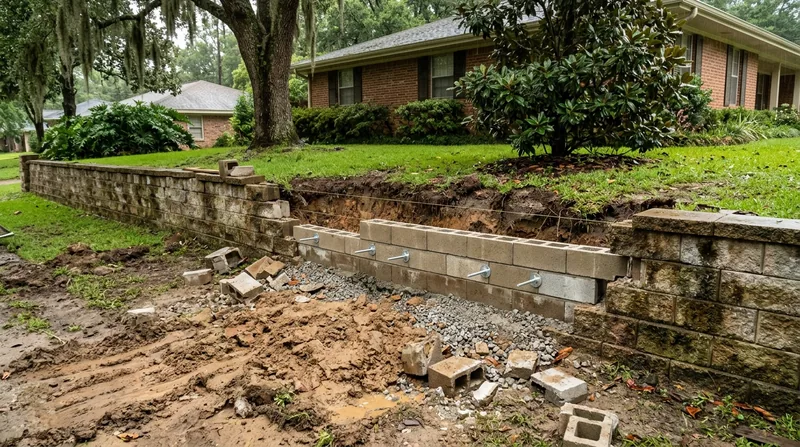




Baton Rouge sits on the first bluff above the Mississippi, where the ground drops from the old terrace along Highland Road into bayou bottomland fed by Bayou Fountain, Ward Creek, and Dawson Creek. That grade change is why so many walls here lean. Add gumbo clay that swells after a week of rain and shrinks in a dry August, a high water table, and storms like Gustav and Ida, and a wall that looked plumb last spring can be two inches out of line by fall. When a wall leans, bulges, or drops a section altogether, you need Leaning & Collapsed Wall Repair in Baton Rouge that starts with the soil and the drainage, not with a fresh coat of paint. We are fully insured, NCMA Segmental Retaining Wall Installer certified, and we work the bluff lots, the bayou banks, and the slab yards from Spanish Town out to Shenandoah. If the wall is holding a driveway, a pool deck, or a raised slab, the clock matters. Call (225) 416-8270 and we will tell you what we see. For walls that are failing but not yet down, our retaining wall repair page covers the smaller fixes.
Why Walls Fail Here: Expansive Clay, Bayou Water, and Big Trees
The dominant failure mode in Baton Rouge is not frost and it is not coastal salt. It is expansive gumbo clay pushing against a wall that was never built for that pressure. When the clay takes on water, it swells and shoves the base and the back of the wall outward. When it dries, it shrinks and the wall loses support, so it tips forward into the void. Layer on a high water table, hurricane rainfall, and root systems from live oaks and magnolias, and you get the bulges we see every week.
- Hydrostatic pressure builds when the wall has no working drain and water stacks up behind the block.
- Tree roots from live oaks and cypress lift footings and pry apart joints over time.
- Old railroad tie and timber walls rot and get eaten by Formosan termites until they lose all holding power.
- Downpours and named storms saturate the backfill faster than it can drain, and the wall moves all at once.
- Slab homes on raised pads in Shenandoah and Central put a surcharge on walls that were never engineered for it.
Most of the leaning walls we open up in Baton Rouge have the same root cause: water in the wrong place. Fix the water and half the repair is already done.
Key info: A wall that leans more than about an inch per foot of height, or that has a visible bulge with cracks running through the block, is past cosmetic repair. In Spanish Town and the Garden District, we regularly find old brick garden walls that were built without a drain and have been quietly pushing outward for decades.
Before any work starts, confirm what your jurisdiction requires. East Baton Rouge Parish and the City of Baton Rouge publish permit guidance through the parish building department, and thresholds vary by wall height and surcharge, so check the official Baton Rouge city-parish site or call the building department directly.
How We Diagnose and Repair a Leaning Wall in Baton Rouge
We do not guess from the curb. The first hour on site is about finding out what is actually moving and why. On bluff lots off Highland Road, that often means digging a test pit at the toe to see how deep the footing sits and whether the clay is saturated. On bayou-bank properties near Bayou Fountain, we look at the grade behind the wall and where stormwater is going. The repair plan follows the diagnosis, not the other way around.
- We walk the wall, photograph the lean and the cracks, and measure how far out of plumb it has moved.
- We dig a test pit at the face to expose the footing, the base course, and the drain.
- We check the backfill and the soil behind the wall for trapped water and clay expansion.
- We determine whether tieback anchors, drainage correction, or a partial rebuild will hold the wall.
- We give you a written scope with the method, the materials, and the price before we touch the wall.
If a wall can be saved with anchors and drainage, we save it. If the block is crumbling or the footing is gone, we tell you straight and price a rebuild.
Key info: On a recent job near the University Lakes, a segmental block wall holding a raised pool deck had bulged six inches over two summers. We installed tieback anchors into the stable clay behind the wall, rebuilt the drain, and replaced the top two courses. The homeowner avoided a full tear-out and the deck stayed usable through the following hurricane season.
If the wall is on a slope that is also eroding, the fix has to address the slope as well. Our slope stabilization and erosion control service covers that side of the problem.
Repair Methods We Use for Leaning and Collapsed Walls
Not every leaning wall needs the same fix. A brick garden wall in Beauregard Town that has tipped two inches is a different job from a poured concrete wall that sheared off its footing after a flood. The table below shows the main approaches we use around Baton Rouge and what each one is built for.
| Approach | Description | Best for |
|---|---|---|
| Tieback anchors | We drive anchors into the stable soil behind the wall and connect them to the face to pull the wall back toward plumb. | Walls that are leaning but still structurally sound, especially tall segmental block walls. |
| Drainage correction | We open the backfill, install a proper drain and filter fabric, and redirect stormwater away from the wall. | Walls pushed out by hydrostatic pressure, common on bayou-bank and bluff lots. |
| Partial rebuild | We remove the failed section, rebuild the footing and base, and reset the block or concrete to match the existing wall. | Walls with a localized collapse or a crumbling base course. |
| Full rebuild with engineered base | We tear out the failed wall and build a new one with a deeper footing, engineered backfill, and a working drain. | Walls that have moved past anchoring, or timber and railroad tie walls that have rotted through. |
| Temporary shoring | We brace a collapsing wall to protect the structure above it until the permanent repair is scheduled. | Emergency situations after a storm or flood, where a driveway or slab is at risk. |
We pick the method that matches the failure, not the one that is easiest to sell. If a wall can be anchored and drained, that is the call we make.
Leaning & Collapsed Wall Repair Cost in Baton Rouge: What to Expect
Most leaning and collapsed wall repairs in Baton Rouge start around $2,500 and go up from there. That starting figure covers a small wall with a localized failure, a drainage correction, and a partial rebuild of a few courses. The number moves when the wall is tall, when the footing has to be replaced, when a driveway or pool deck sits above it, and when access is tight.
- Wall height and length drive the material and labor cost more than anything else.
- Access matters on bluff lots and bayou banks, where equipment cannot always reach the back of the wall.
- Tree removal or root cutting may be needed before the wall can be stabilized.
- Proximity to a structure or a raised slab raises the stakes and the engineering.
- Emergency shoring after a storm adds a line item that a planned repair does not have.
Get two or three written estimates and compare the scope, not just the total. A low number that skips the drain will cost you again in two years. Our full pricing overview lays out how we build a number.
Leaning & Collapsed Wall Repair Near Me: How to Choose a Contractor Near Baton Rouge
You want a contractor who has actually dug into gumbo clay and knows what a Baton Rouge footing looks like when it has been sitting in water. Ask questions before you sign anything, and do not be shy about it. A good contractor will answer all of them without flinching.
- Ask for proof of insurance and confirm the company carries general liability and workers compensation coverage.
- Get at least three estimates and make sure each one lists the repair method, the drainage plan, and the materials.
- Ask for references from jobs in Baton Rouge, ideally walls similar in height and setting to yours.
- Confirm who pulls the permit if your wall is above the local threshold or supports a surcharge.
- Check HOA rules before you start, since some subdivisions in Shenandoah and Central restrict wall height and materials.
If a contractor will not put the scope in writing or cannot explain why your wall moved, keep looking. You can reach us through our contact page for a free estimate.
Leaning & Collapsed Wall Repair in Baton Rouge: Pricing Guide
| Service | Price | Details |
|---|---|---|
| Drainage correction and partial rebuild | Starting at $2,500 | Covers opening the backfill, installing a drain, and resetting a few failed courses on a low wall. |
| Tieback anchor stabilization | Starting at $4,500 | Anchors a leaning but sound wall back toward plumb, priced by wall height and anchor count. |
| Full rebuild with engineered base | Starting at $8,500 | Tear-out and rebuild with a deeper footing and working drain, priced by length and access. |
| Emergency shoring after a storm | On estimate | Needs an on-site look to assess collapse risk and protect the structure above the wall. |
| Travel | Included | In Baton Rouge and surrounding areas, no separate call-out or mileage fee. |
| Estimate | Free | Response within 24h at (225) 416-8270, no obligation to book. |
Indicative pricing, the exact cost depends on square footage, finish, and site access. Free personalized estimate within 24h at (225) 416-8270.


