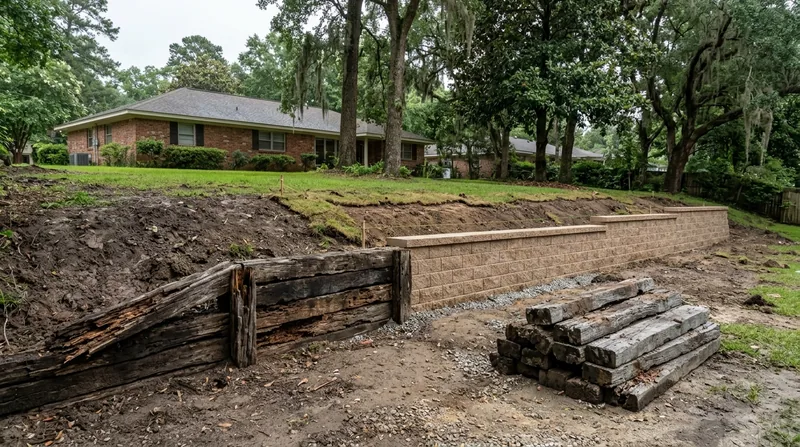




Railroad Tie Wall Replacement in Baton Rouge
Baton Rouge sits on the first bluff above the Mississippi River, and that geography decides which walls fail first. The land drops from the old terrace along Highland Road to bottomland threaded with Bayou Fountain, Ward Creek, Dawson Creek and Bayou Manchac, and the gumbo clay under all of it swells in wet weather and shrinks in drought. If you own a home with an 1980s or 1990s railroad tie wall, you already know the pattern: ties black with creosote, leaning out of line, hollowed by Formosan termites. Railroad Tie Wall Replacement in Baton Rouge means pulling those ties out, hauling them off, and rebuilding the wall in block, concrete or brick with real drainage behind it. We handle the demolition, the gravel backfill and the new wall, and we do it on lots from Spanish Town to Shenandoah. Call (225) 416-8270 for a free estimate. If your wall is still standing but moving, start with retaining wall repair before the lean gets worse.
Why Railroad Tie Walls Fail Faster in Baton Rouge Than Anywhere Else
Creosote-treated ties were sold as a 30-year wall. In this climate they rarely make 20. The combination of subtropical downpours, a high water table and Formosan termites turns a tie wall into a termite highway that runs straight to your house, and the expansive clay pushes the wall out of line while the ties rot from the inside. That is why we see so many leaning tie walls on bluff lots off Highland Road and on bayou-bank properties near Ward Creek.
- Formosan termites tunnel through creosote ties and hollow them out from the core, leaving a shell that looks solid until it collapses.
- Gumbo clay swells against the back of the wall in wet seasons and shrinks in drought, so the ties rack and step out of line.
- Original tie walls were built with little or no gravel backfill, so water sits against the wood instead of draining away.
- Hurricane rain from storms like Gustav and Ida, plus the 2016 Comite and Amite river flooding, saturated walls that were already compromised.
- Creosote ties are heavy, chemically treated and hard to dispose of, so old walls get patched instead of replaced until they fail outright.
Every one of those failure modes is fixable, but not by adding another tie on top. The wall has to come out and the drainage has to be rebuilt.
Key info: A tie wall in Broadmoor that looks fine from the driveway can be hollow behind the face. We probe the ties during the estimate, and on more than one Sherwood Forest job the probe went straight through the timber into a termite gallery.
Before you schedule anything, check the permit threshold with the City of Baton Rouge Parish building department, since walls over roughly 4 feet from the footing, or walls holding a driveway or structure, usually need a permit and sometimes engineered drawings.
How We Tear Out and Rebuild a Railroad Tie Wall in Baton Rouge
We do not patch tie walls. We take them down to the footing, get the creosote timber off your property, and rebuild with a material that will outlast the house. The sequence matters, because a new wall dropped onto an old, clay-slicked footing will lean within two seasons.
- We walk the wall and probe the ties, then mark utilities and confirm the permit threshold with the parish before any demolition starts.
- We cut and pull the ties in sections, load them out and haul them to an approved disposal site, since creosote timber cannot go in a residential dumpster.
- We strip the old footing and excavate back into the slope far enough to fit clean gravel and a drainage plane behind the new wall.
- We set a new compacted base, install perforated drain pipe and washed gravel, and wrap the backfill in filter fabric so clay cannot clog the drain.
- We build the new wall in segmental block, poured concrete or brick, compacting the backfill in lifts as the courses go up.
- We cap the wall, restore the grade and clean the site, then walk it with you before we leave.
On a recent job in Oak Hills Place, the old tie wall held a terraced bed below a pool deck. We rebuilt it in segmental block with a gravel drainage plane tied to a French drain, and the homeowner got the deck back without a single cracked slab.
Key info: We rebuilt a failing tie wall on a bluff lot off Highland Road where the clay had pushed the ties 8 inches out of plumb. The new block wall went in with a drainage plane and a toe drain, and it has held through two hurricane seasons.
If your existing wall is timber but not creosote tie, the same tear-out logic applies, and you can read more on our timber retaining walls page. For tie walls that are actively collapsing, go straight to leaning and collapsed wall repair.
Replacement Options for an Old Railroad Tie Wall
Once the ties are out, you have a real choice about what goes back in. The right answer depends on height, what the wall is holding, and how the lot drains. Here is how the main approaches compare on Baton Rouge ground.
| Approach | Description | Best for |
|---|---|---|
| Segmental block (SRW) | Interlocking concrete block with gravel backfill and a drainage plane, built to NCMA segmental wall standards. | Most residential tie wall replacements, terraced beds and driveway grades. |
| Poured concrete | Reinforced concrete wall formed and poured on site, with weep holes and drain rock behind the face. | Tall walls, walls holding a slab or structure, and tight lots where block is impractical. |
| Brick | Brick veneer over a structural core, matched to the house and the historic district streetscape. | Garden District, Capital Heights and Spanish Town homes where appearance matters. |
| Boulder and natural stone | Rock wall set into the slope with gravel drainage, no mortar face to crack. | Bayou-bank lots, wooded properties and low walls where a natural look fits. |
Whichever material you choose, the drainage behind it does the real work. A block wall with no gravel backfill fails just as fast as the tie wall it replaced.
Railroad Tie Wall Replacement Cost in Baton Rouge: What to Expect
Pricing for a tie wall replacement starts at From $35/sq ft for a standard segmental block rebuild with new gravel backfill and drainage. That figure moves with wall height, access, what the wall is holding, and how much old timber has to be cut out and hauled. A 30-foot garden wall in Capital Heights and a 60-foot terraced wall on a Highland Road bluff lot are not the same job, even at the same square footage.
The biggest cost swing is demolition and disposal. Creosote ties are heavy, treated and cannot go in a curbside can, so haul-away is a real line item. Access is the second factor: a wall behind a pool cage or down a narrow side yard in Southdowns takes more labor hours than one you can back a truck up to. Material choice and drainage scope finish the picture.
Get two or three written estimates and compare scope, not just the bottom line. Ask whether the price includes tie removal, haul-away, new gravel backfill and drain pipe, or only the new wall face. Our full pricing overview breaks down what drives the number.
Railroad Tie Wall Replacement Near Me: What to Check Before You Hire
Anyone with a truck can pull ties. Rebuilding the wall so it stays put is the part that matters. When you are comparing contractors near Baton Rouge, ask the same questions on every call and write the answers down.
- Ask for proof of insurance and a certificate of coverage before work starts, and confirm the crew is covered on your property.
- Get two or three written estimates and make sure each one lists tie removal, haul-away, backfill and drainage separately.
- Ask for references from jobs in your part of town, and go look at a wall the contractor built two or three years ago.
- Confirm who pulls the permit if your wall is over the parish threshold or holds a driveway or structure.
- Ask how they handle a wall near protected trees or in a historic district, where extra review can apply.
- Check HOA rules before demolition day, since some subdivisions restrict wall height, material and color.
We are fully insured, hold NCMA Segmental Retaining Wall Installer Certification, and we will show you the certificate on request. To book an estimate, use our contact page or call (225) 416-8270.
Railroad Tie Wall Replacement in Baton Rouge: Pricing Guide
| Service | Price | Details |
|---|---|---|
| Standard tie wall replacement, block | Starting at $35/sq ft | Includes tie demolition, haul-away, gravel backfill, drain pipe and a new segmental block wall. |
| Brick or concrete rebuild | Starting at $45/sq ft | Includes structural core, brick veneer or formed concrete, weep holes and drain rock. |
| Tall or surcharged wall | On estimate | Walls over 4 feet or holding a driveway or structure need an on-site look and possibly engineering. |
| Difficult access or heavy demolition | On estimate | Pool cages, narrow side yards and deeply rotted ties add labor hours that must be seen to price. |
| Travel | Included | In Baton Rouge and surrounding areas, no separate call-out or mileage fee. |
| Estimate | Free | Response within 24h at (225) 416-8270, no obligation to book. |
Indicative pricing, the exact cost depends on square footage, finish, and site access. Free personalized estimate within 24h at (225) 416-8270.


